Artwork Appreciation
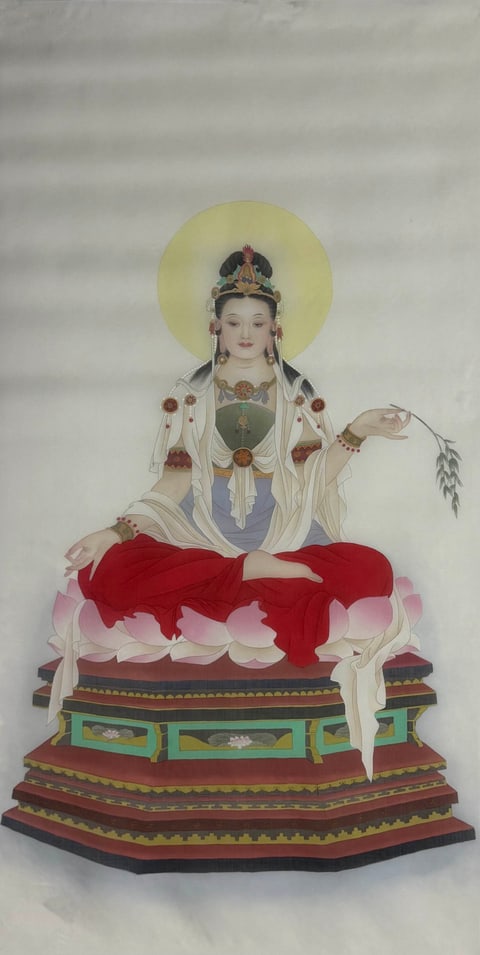
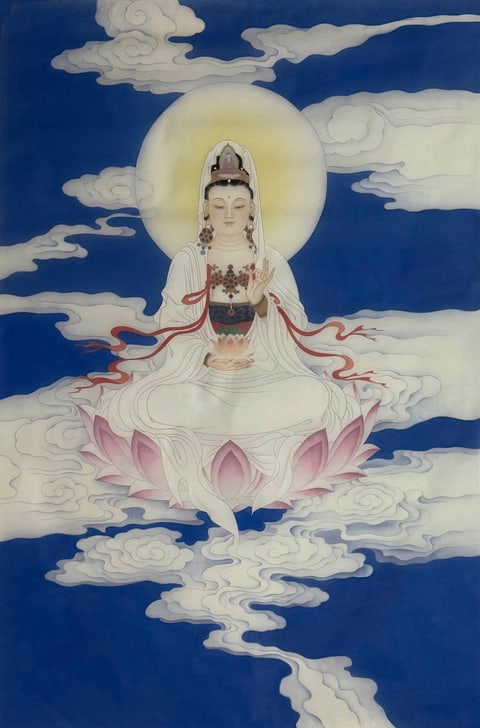
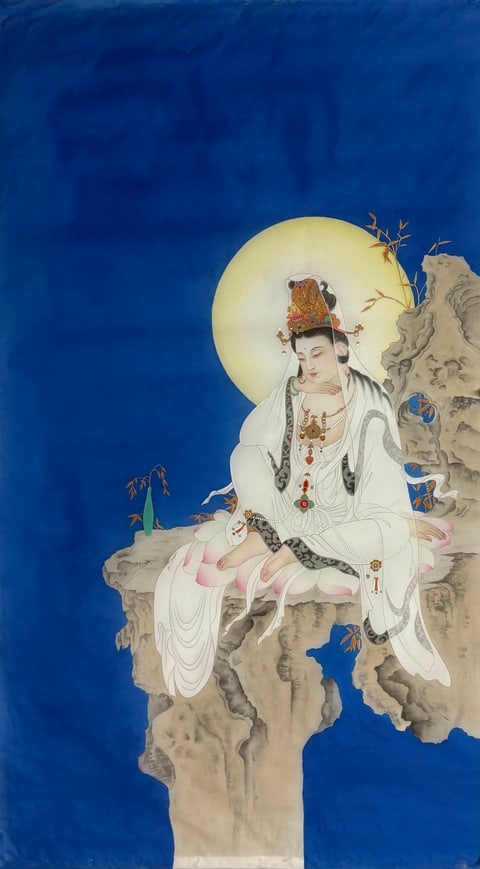
This work exemplifies devotional artistry through meticulous techniques. The facial rendering achieves spiritual resonance: feathered ink lines define a compassionate countenance, with subtle flesh-tone washes modeling full cheeks; downcast eyes are painted with hair-thin strokes—pupils focused inward—embodying contemplative serenity. Symbolic color coding manifests in materiality: the white robe layered with translucent washes mimics silk luminosity, while indigo undergarments (azurite base with indigo glaze) harmonize with the blue lotus throne; the crown and necklaces employ raised paste gilding (沥粉堆金), highlighted with polished gold and shadowed with umber.
Compositionally, dynamic stillness prevails: the figure’s adamantine lotus posture (static meditation) contrasts with freely brushed purple-blue leaves arcing downward (ephemeral vitality), creating a dialogue on impermanence. The abhaya mudra (无畏印) is anatomically precise—vermilion palm marking the dharmachakra, fingers extended per iconometric canon. The halo, softly graded from ochre to void, avoids rigidity through atmospheric diffusion. Crucially, the technical rigor (工笔) never overshadows spiritual poetics; gold ornaments radiate without ostentation, and the floating leaves impart lyrical grace. This synthesis of Tang dynasty devotional precision and Song dynasty ink subtlety elevates sacred art beyond ritual into aesthetic contemplation.
Applicable Spaces
Zen meditation rooms, Oriental art museum Buddhist halls, luxury hotel cultural vestibules.
Artwork Tags
Meticulous Bodhisattva | Blue Lotus Throne | Abhaya Mudra | Raised-Gold Ornaments | Floating-Leaf Poetics | Modern Buddhist Art