Artwork Appreciation
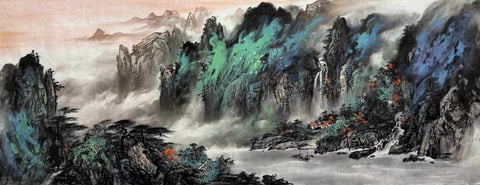
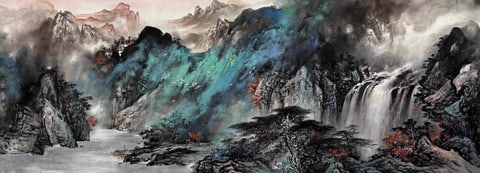
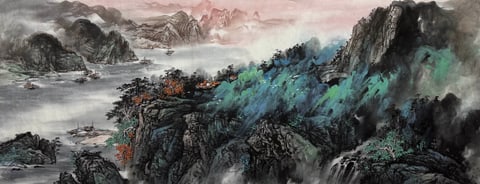
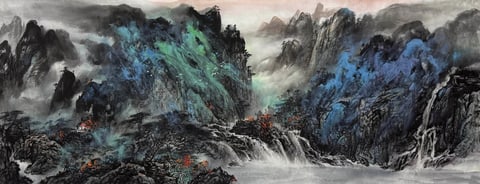
This landscape reinvents classical traditions through chromatic calligraphy. Ink-brush stratigraphy mimics geology: axe-cut strokes (斧劈皴) fracture cliff faces, hemp-fiber lines (披麻皴) weave distant ridges, while azurite/malachite glazes echo Wang Ximeng’s blue-green legacy. Vermillion-orange dots—applied with “skipping brush” technique—ignite sunlit slopes as chromatic epiphanies.
Spatial metaphysics manifests in mist: graded washes (“接染法”) transition from inky peaks to void, simulating mountain respiration; water surfaces deploy strategic emptiness—nearshore reflections in pale ink, open areas pure paper-white—creating a Zen gradient from substance to transcendence. Vignettes embody philosophical codes: boats sketched in three ink strokes, figures reduced to dots, their tilt implying “journey as meditation”; houses rendered boneless-style with voided windows become unreachable utopias.
Color grammar innovates within tradition: cool glazes (azurite in shadows) and warm accents (vermilion on crests) follow natural light logic, yet ink underpinnings perpetually discipline color’s exuberance, upholding the Confucian principle “ink as sovereign, color as vassal” (墨主色辅). The work ultimately transcends representation, becoming a meditation on existence through landscape syntax.
Applicable Spaces
Oriental art galleries, Zen-inspired lounges, collector’s private studies
Artwork Tags
Ink-Color Landscape | Blue-Green Legacy | Dot-Accent Technique | Boat-House Metaphysics | Three-Distance Space | Modern Evolution